
Honoring Marlowe: A Life of Service Above Self
By Lacey Jensen
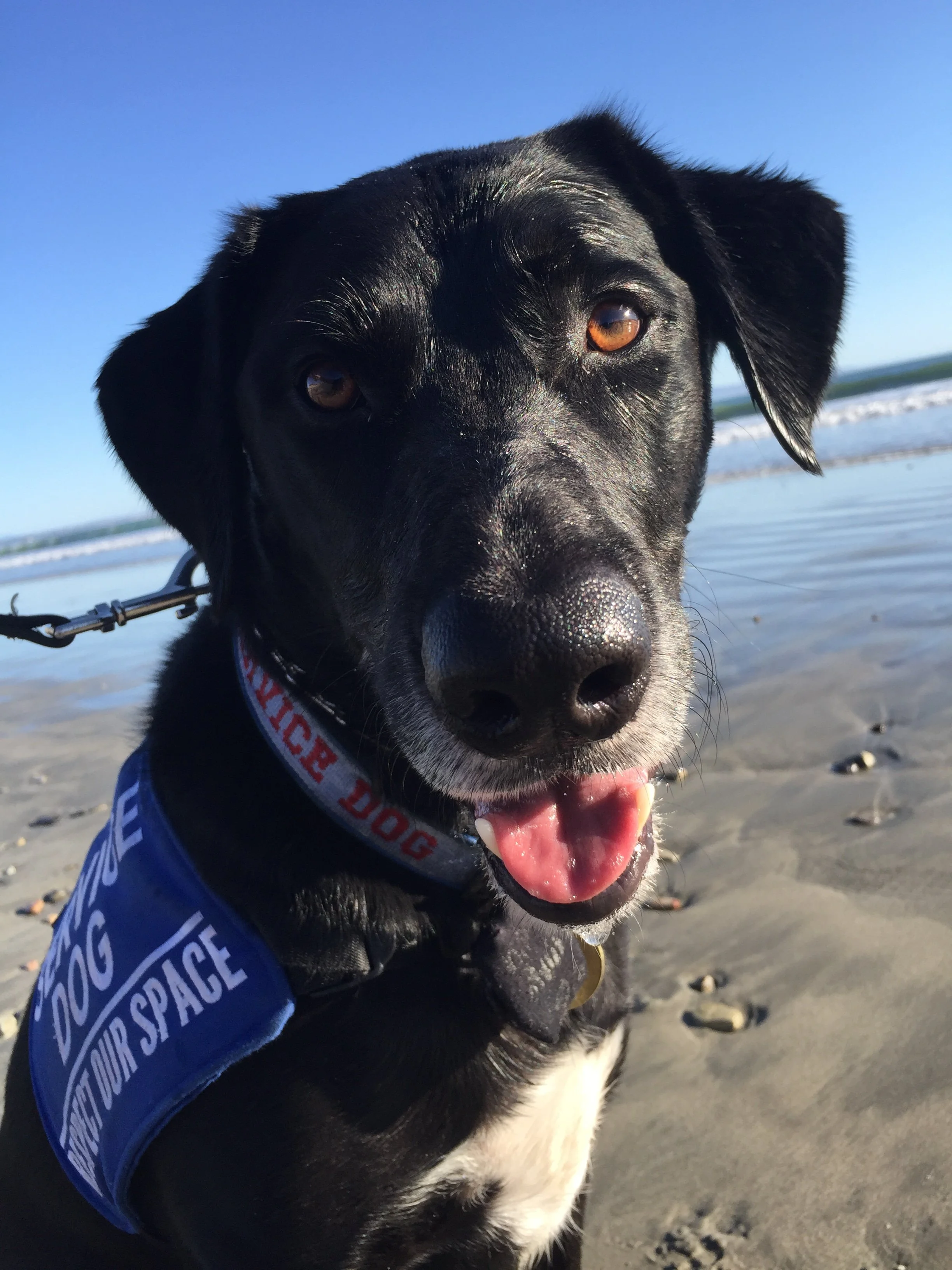
Marlowe was my service dog for over a decade. He was strength and devotion with paws, fur, and a vest.
I wasn’t in Rotary when Marlowe came into my life. I wasn’t involved in anything. I was nearly house-bound with frequent and severe panic attacks. I have PTSD and survived a traumatic brain injury. Two doctors I trusted leaned into the idea of me getting a service dog. It took me a while to warm up to the idea, but I didn’t have anything to lose and everything to gain.
I wasn’t raised to give up; my mother survived Polio with a lasting physical disability but that never stopped her from what she wanted.
Non-profit organizations who offer service dogs that would have met my needs were asking around $30,000 (as a ‘donation’) for a fully trained dog. We have many wonderful programs that offer service dogs to veterans free-of-charge, but I was the former military spouse. I wasn’t ever going to be at the top of a waitlist over a veteran. So, I bought a book on training my own service dog which included how to pick a puppy. Being at home gave me the time to take matters into my own hands.
If you know nothing else about me, you have to know that I persevere no matter what I’m faced with. I’ve never seen life any other way.
My husband’s co-worker’s dog had a litter of unwanted puppies. Her dog was a pure-breed New Zealand Cattle Dog and the puppies’ father was a ‘black shape in the night.’ Clearly a lab or a lab mix from the looks of the puppies. She was giving these farm puppies away for free. I started testing the puppies following the instructions in the book and selected Marlowe. The puppies were only four-weeks old, despite the woman giving them away claiming they were weaned. He was smaller than my flip-flop. I immediately bought a collar and came back, asking her to give him just a little bit longer with his mother. Two weeks later, she called saying everyone wanted the puppy with the collar and we had to come get him, so I brought Marlowe home at six-weeks of age and we started his training.
I hired multiple dog trainers to work with us, starting him at eight-weeks old. As I was always home, I spent the bulk of my time working him through everything the trainers showed us. I called it the DIY service dog approach, or the pay-as-you-go model. My favorite trainer took us to stores while she trained other, older service dogs. I researched the laws and made sure Marlowe was everything a ‘real’ service dog would be and licensed him through the County and State. He was never a pet posing as a service dog. He also became certified as a K9 Good Citizen. He was classified as a medical alert and response service dog.
Marlowe got me out of the house. He was strong for me when I couldn’t be. And I always knew he could handle any situation. There was no stopping him if he decided I wasn’t OK. Once, he climbed into the bathtub with me to ground me as he was trained to do when I was in distress. I began to tell people that he was a highly trained professional and if he declared something was wrong, I needed to listen.
I would sometimes meet in-person with a client that was in Rotary. He always wore the pin on his shirt collar. I asked him about it once, knowing that Rotary led the way in eradicating Polio and was curious if that was still a mission. He offered to bring me to a meeting. By that point, I was starting to seek more interactions as I tried to resume my prior levels of social activity before the traumas. And where I thought bringing along a service dog would be an unwelcome addition after trying out a different organization that explicitly stated my service dog wasn’t welcome (they claimed he was a distraction), I found the Rotary Club to be very welcoming and caring. There are always curious people who ask inappropriate questions in public, but the inquisitive members handled my answer that my disability is personal with grace.
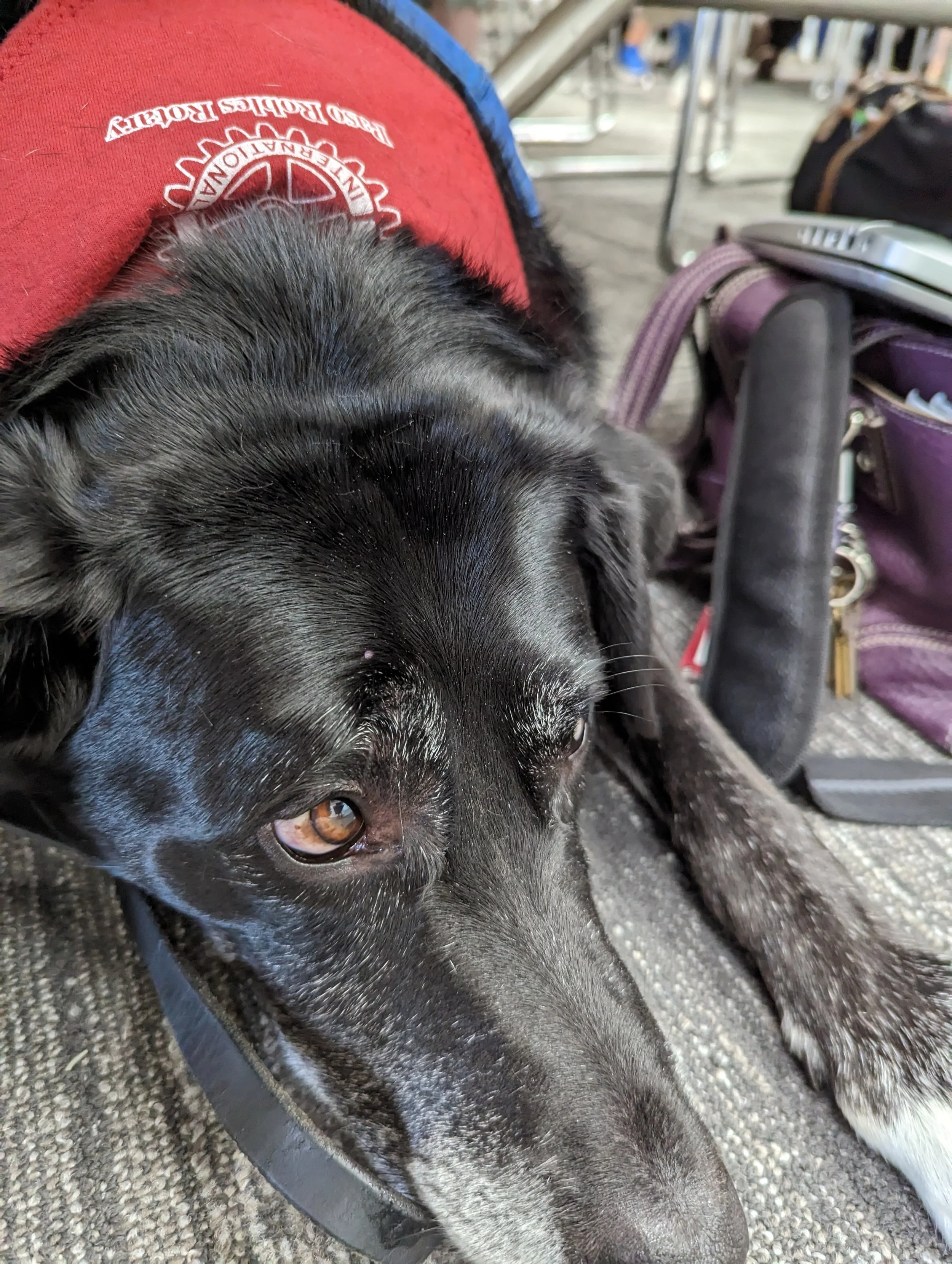
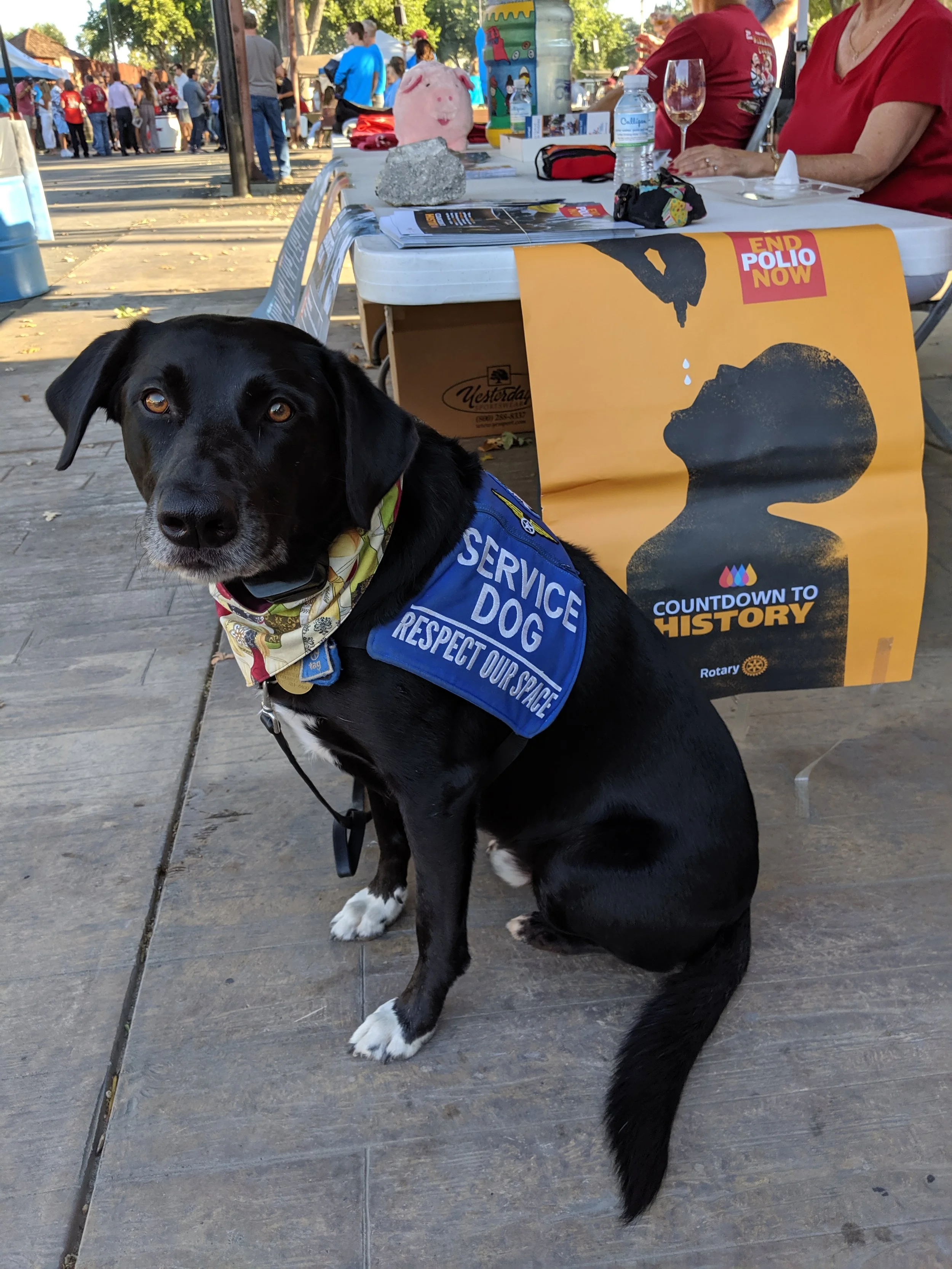
The Club I joined holds two annual fundraisers raising money for local kids, which was a big part of my decision to join. I wanted to help. My first year, they had a Polio Information Booth at the event and I asked to station it. After the first few years of having a service dog I had learned two key things about interacting with a dog in public: firstly, people ask inappropriate questions and think they are owed an answer, which I learned how to navigate with help; and secondly that the dog is disarming to most people and they feel more comfortable in approaching (which does lead to problem number one, but that’s just the reality of being out in public). I made a red Rotary bandana for Marlowe out of a t-shirt (this was before Kennel Klub) and we stood in front of the booth where we could be seen. Lots of people felt comfortable walking up to the booth and talking to me. As always, I graciously declined the requests to pet him as he was on duty, but I did get to answer a lot of questions about Polio. Marlowe stood strong at my side in a flood of strangers while I answered questions. That is something I could never have done without him.
Our society likes to think Polio is done and vaccines are bad. My whole life was shaped by Polio and I know I’m not alone. It is a cause that continues to need public education and community support.
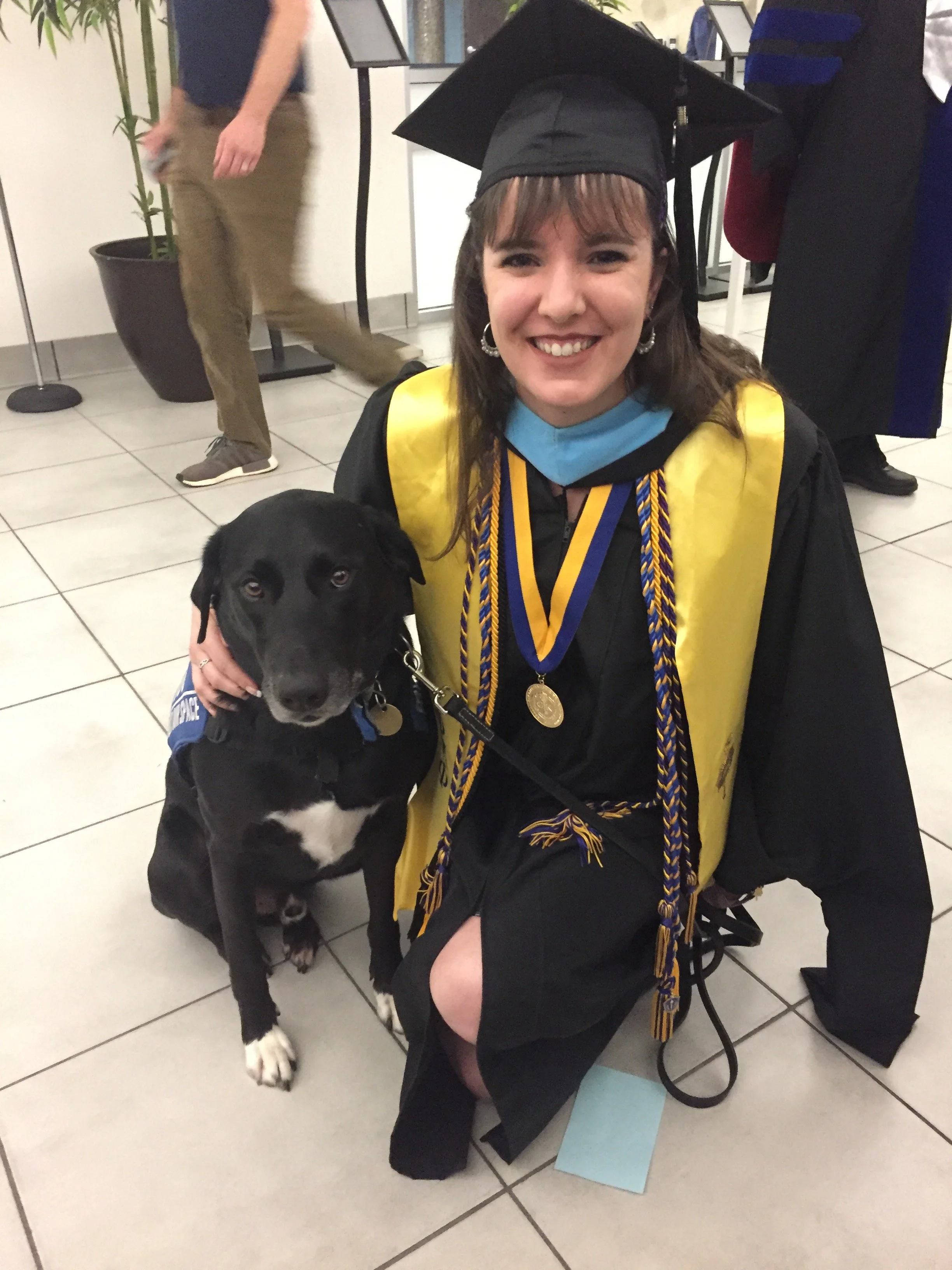
Marlowe lived an exceptional life of service. He took me on airplanes and stood by me at conference presentations and while I gave workshops. He went on the tour of Pearl Harbor with me. He walked with me as I received my Master’s degree and led the procession at my wedding. He devoted himself to my wellbeing and gave me back my life. If anyone is the embodiment of Service above Self, it was Marlwoe. Marlowe is now my angel with fur, paws, and a vest and will forever live in my heart.